
Cancel
Top tips

Simulation and test bench: this is how we study lubricants for hybrid engines
09 April 2026
Lubricants are not developed just in the laboratory and with engine tests. To truly understand how an oil behaves, it's necessary to combine different analytical tools. Among these are simulation tests, which are gaining greater importance thanks to their ability to anticipate scenarios.
We've already talked about how simulations help study formulations more quickly and accurately, but this time we want to put the idea into practice with an analysis of oils for hybrid engines. It offers a very illustrative example of how both methodologies complement one another when the combustion engine is not working continuously and the lubricant has to deal with different operating conditions.
Why oil's behavior changes in a hybrid
Lubricant validation has long combined experimental work with modeling tools. The logic is simple. The simulation allows you to reproduce scenarios, compare behaviors, and advance faster in the analysis, while the physical test lets you check if the model faithfully represents what happens inside the engine.
In the case of hybrids, this combination is especially useful, since these engines have operating conditions that deserve a specific look. This is because a hybrid vehicle's thermal engine starts and stops running according to power demand, battery charge level, or style of driving. Also, the electric motor may assume a relevant share of the work in cities, on interurban roads, and even on certain parts of the highway.
As a result, combustion engines do not always reach or maintain the same conditions in a hybrid vehicle as they would in a conventional vehicle. This is extremely important for lubrication, as the oil may take longer to heat up, need to work longer at lower temperatures, or face more intermittent operating sequences. All of this influences variables such as friction, consumption, or protection against wear and tear.
In other words, hybrids not only change how the vehicle moves, but also change the actual context in which the lubricant has to fulfill its function.
What simulation brings to hybrid lubricant analysis
This particularity has led to a joint study between Repsol TechLab and the University of Valencia, which analyzes the behavior of low-viscosity lubricants in hybrid vehicles, illustrating how these two forms of testing are combined in practice.
The first part of this work is based on an advanced numerical model capable of reproducing the behavior of the vehicle, the engine, and the lubricant in different scenarios. In this case, a Renault Captur HEV was used as the basis in a comparison of the performance of various oils of different viscosity in approved cycles and in real driving routes.
The contribution of the simulation is very valuable because it allows us to observe, under the same framework of analysis, how variables evolve that are directly related to the lubricant's behavior. These may include, for example, oil temperature, friction losses, fuel consumption, or lubrication conditions in critical engine components.
It also gives you a closer look at what happens in complex use situations. In a hybrid, the thermal engine does not follow a linear pattern. There are phases in which it remains off, others in which it starts running to cover a specific part of demand, and still others in which it works in combination with the electrical motor. A simulation helps structure that scenario and translate it into comparable data. As a result, this allows you to anticipate behaviors and better understand what will be validated later in the engine laboratory.
What the engine laboratory contributes to validating the lubricant
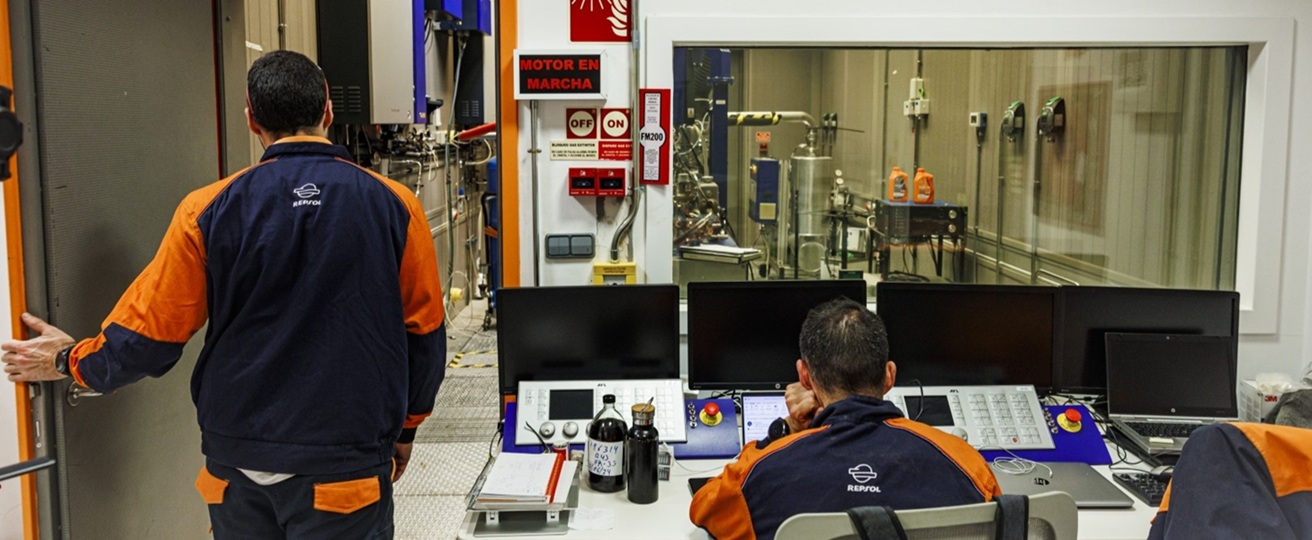
The second part of the process is to place the hypothesis in a real-world environment. In the engine laboratory, we measure the system's actual behavior under controlled conditions, with special attention to parameters such as consumption, oil temperature, or changes in the lubricant during the test.
In this case study, the work on the test bench served to replicate the engine's operation under strategies compatible with hybrid use and compare that data with those obtained in the simulation. In other words, the laboratory was the step we needed to confirm that the model correctly reflected what happens in practice, providing a true reference from which to adjust, contrast, and reinforce the model's robustness.
Once validated, the model becomes useful and can be applied to new scenarios to compare formulations and expand the analysis without relying exclusively on longer, more expensive tests with real engines.
Related content
Simulation and test bench: this is how we study lubricants for hybrid engines
Learn how simulation and our test bench are combined to analyze the behavior of lubricants in hybrid engines.
Show more
09 April 2026

John Roskott (Valtec): "We want to double our business in the next 5 years"
John Roskott, CEO of Valtec, analyzes the keys to the market in Central and Eastern Europe: logistics, service, commercial network, and growth.
Show more
07 April 2026

Long car journey: how to check the oil and avoid breakdowns
Use these maintenance tips to prevent surprises during long road trips. Start reading to prepare your next adventure.
Show more
26 March 2026