
Cancel
Top tips

Repsol's return to MotoGP: our history in motor racing
03 February 2026
The MotoGP World Championship is about to begin, and it will do so with Repsol Lubricants as the exclusive supplier of lubricants for the Moto2 and Moto3 categories. The agreement, signed with Dorna Sports, covers the 2026 season to 2030 and reinforces the brand's vocation to turn engineering into real experiences of performance and trust.
Repsol's return to the Motorcycling World Championship is the natural continuation of a history that, for decades, has united laboratories and circuits. Every weekend, Moto2 and Moto3 riders will test the lubricants developed at the Repsol TechLab, with a formulation that will also be available in commercial products. In this way, the circle between the learnings that go from the track to the street is closed, and vice versa.
Taking advantage of this event, we will review Repsol's history in motor racing over the years.
Repsol's history in motorsport
H3: Origins with a rally smell: Escudería Repsol (1969–1973)
Our relationship with motorsport began in 1969 with the Escudería Repsol, a project that brought the brand's colors to the world of rallying and quickly garnered national success.
That first stage laid the foundations of a way of working that still lasts: preparing, testing, learning, and trying again, with perseverance and demand. That competitive pulse, between workshop and track section, defined a personality that soon looked to a greater horizon.
The jump to the Motorcycling World Championship (1971–1989)
In 1971, Repsol debuted in the Motorcycling World Championship alongside Derbi and Ángel Nieto, who won the 125cc title. One year later, Nieto achieved the world double in 50cc and 125cc, consolidating a relationship that marked an era and brought the brand closer to fans.
The eighties added more milestones. Now in 1988, Jorge Martínez 'Aspar' added the 80cc and 125cc titles, while Sito Pons - with the colors of Campsa - was crowned in 250cc. A year later, Álex Crivillé would win the 125cc World Championship, the prelude to his jump to the premier category, in which he would become champion in 1999.
The Repsol Honda era (1995–2002)
The 1990s brought an alliance that would become iconic. Repsol Honda Team was born in 1995. With Mick Doohan, it begun a hegemonic stage in the top category, with four consecutive titles. Then, in 2002, Valentino Rossi would inaugurate the MotoGP era as champion with the team.
It wasn't just a matter of victories. Week after week, the gears of the Repsol Honda Team proved to be perfectly greased to make the difference.
Generations that marked an era (2007–2025)
The story didn't stop there. In 2010, Marc Márquez entered the Olympus with the 125cc title and, in 2016, became the youngest five-time champion in history, adding titles in several categories. But Repsol's history in two-wheel racing goes beyond MotoGP.
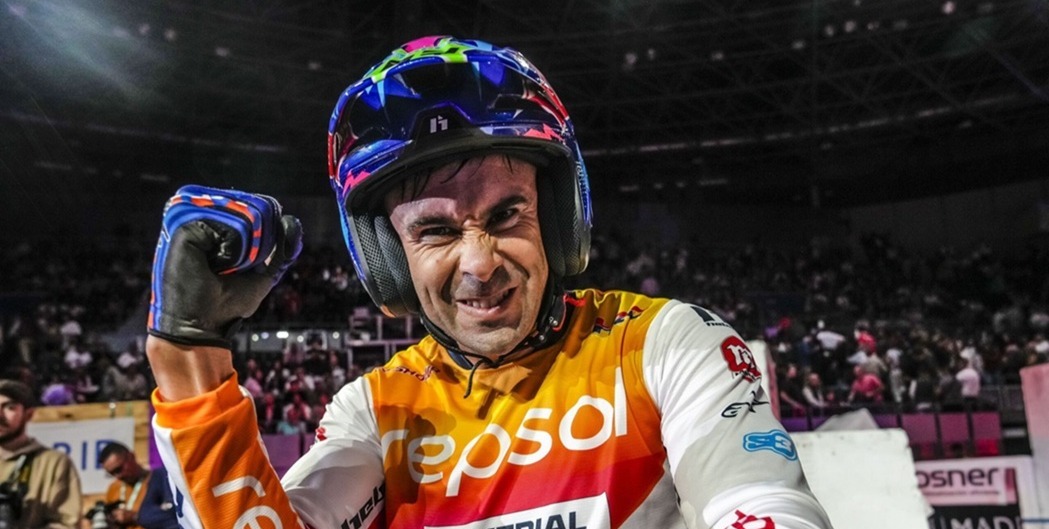
In trial, Toni Bou raised his own bar. Since 2007, the rider has won titles until achieving his 38th world championship in 2025. A figure that speaks of mastery, precision, and technical work validated year after year. In this decade, Laia Sanz also became a benchmark in women's motorcycling, adding different championships with Repsol Honda-Montesa.
Four wheels, same demand: Formula 1, Rally, and Dakar
Repsol's competitive DNA has also been written on four wheels. In the World Rally Championship, Carlos Sainz won the 1990 and 1992 titles with Toyota, with the Repsol livery etched in fans' memories. In this decade, the brand also entered Formula 1 along with Jordan, with Pedro Martínez de la Rosa as test driver.
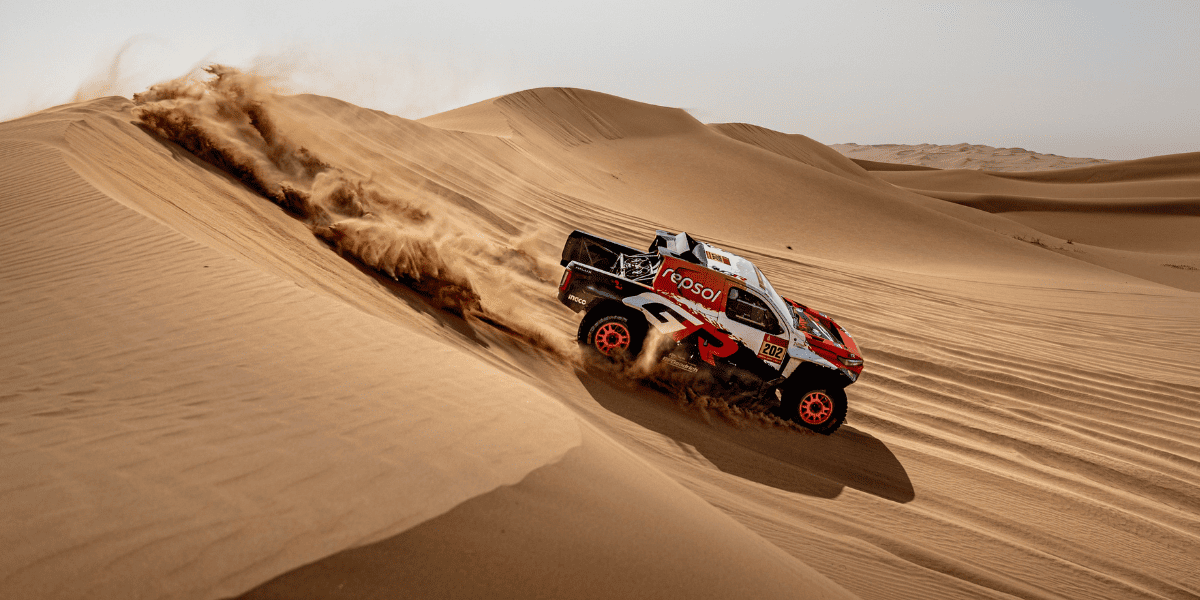
The Dakar Rally added another page to Repsol's motorsport history. In 2004, Nani Roma made history and, with Repsol KTM, became the first Spaniard to win in this competition. Afterwards, the driver would continue in the Dakar Rally on four wheels with Repsol Mitsubishi Ralliart. This team was one of the most dominant in this Dakar competition, taking numerous victories alongside iconic riders such as Stéphane Peterhansel.
Innovation and sustainability
In recent years, the competition-innovation pairing has added a new territory: sustainability. In 2022, Repsol supplied 100% renewable fuel to the French Formula 4 Championship, a world pioneer in using fully renewable fuel for a full season. Two years later, the collaboration with Honda in MotoGP aligned with the requirement that 40% of the fuel be of non-fossil origin.
In addition, the technological agreement with Toyota Gazoo Racing brought a fuel with 70% renewable components and lubricants with a renewable base to the 2026 Dakar Rally. Both reduce the use of fossil raw material without compromising performance.
However, taking care of memory is also taking care of the future. That's why, since 2008, the Repsol Classic Team has been participating in historic rallies to preserve vehicles that are part of the motor memory. It is an active tribute to the brand's heritage and a way of continuing to tell the story that brought us here with exactitude.
Moto2 and Moto3: what the return of Repsol implies
All this trajectory sums up a way of understanding innovation: tests at the extremes that accelerate development, ensuring performance and reliability. That’s why, being an exclusive supplier of lubricants in Moto2 and Moto3 means testing formulations under real stress - high temperatures, prolonged speeds, constant load changes - reducing friction where every thousandth counts.
Thus, when the traffic light goes out at the first race of the year, a continuous learning cycle that goes from your vehicle to the track, passing through the laboratory, will also be accelerated.
The ambition is clear: that every lap adds knowledge and that every learning process reaches the street and the track as soon as possible. Because competing is not only winning, but also transforming engineering into real confidence, day after day. Repsol Lubricants, again, on the starting line.
Related content
Long car journey: how to check the oil and avoid breakdowns
Use these maintenance tips to prevent surprises during long road trips. Start reading to prepare your next adventure.
Show more
26 March 2026
How often do I need to change the oil in my car and motorcycle?
Learn when you should change the oil in your car or motorcycle, how to spot signs of wear, and how to keep your vehicle in tip-top condition.
Show more
19 March 2026
How to properly check your motorcycle's oil
Learn how to check your bike's oil in this step-by-step guide with common errors and tips on how to fill it up perfectly.
Show more
12 March 2026