
Top tips

Outboard motor oil: 2-stroke vs 4-stroke, how to choose
20 October 2026
If you want to take care of your outboard engine, you should not choose just any oil: a 2-stroke and a 4-stroke engine have completely different lubrication needs. In this guide we review the differences between the two technologies, what standard and viscosity each oil must meet, and why using a lubricant designed for a car or motorcycle in a marine engine can end up in an expensive breakdown.
At Repsol Lubricants, we work with repair shops, nautical distributors, and private users who need a clear reference before filling up the oil on their vessel. That's why we offer you our range of marine lubricants, designed to meet these needs. Let’s take it step by step.
Differences between 2- and 4-stroke outboard engines
Before talking about oils, we must understand how each type of engine works, because everything else stems from this.
A 2-stroke engine completes the combustion cycle (intake, compression, explosion, and exhaust) in just two piston strokes, i.e., one full revolution of the crankshaft. It is a simpler and lighter design, but it has a key feature: it does not have a separate crankcase. The lubricant is mixed with the fuel (or injected separately in direct grease systems) and burned along with the gasoline to lubricate the piston, cylinder, and bearings.
A 4-stroke engine, on the other hand, needs four piston strokes (two crankshaft turns) to complete the cycle, just like a car engine. It has a crankcase that stores the oil permanently, a pump that circulates it, and a filtration system, very similar in concept to that of a car engine.
This difference in architecture has direct consequences for maintenance:
- 2-stroke engines are generally lighter and simpler, but they consume oil continuously (it burns with the fuel) and generate more emissions if they are not properly tuned.
- 4-stroke engines are quieter, more efficient in consumption, and do not burn the oil: it degrades with use and must be changed periodically, like in a car.
- The type of lubricant that each needs is not interchangeable, and neither are they with automotive oils, as we will see later.
What oil does a 2-stroke outboard need?
In a 2-stroke engine, the oil and fuel mixture has a very demanding mission: it must lubricate the engine while burning next to the fuel, leaving the minimum amount of residue possible and without creating deposits that will obstruct the spark plug or the exhaust
That is why 2-stroke outboard oils are formulated with special detergent and anticorrosive additives for the marine environment, and with clean combustion as an absolute priority: the less smoke and the less carbon residue it leaves, the better protected the engine will be and the fewer emissions will be generated.
TC-W3 standard and mixing ratio
The most common technical reference for 2-stroke oils for nautical use is the TC-W3 standard (Two-Cycle, Water-Cooled, version 3), developed by the NMMA (National Marine Manufacturers Association) specifically for water-cooled outboard engines. A TC-W3 approved oil has been tested to ensure lubricity, resistance to corrosion in fresh and salt water, and low deposit formation in marine working conditions, very different from those of a motorcycle engine or a chainsaw.
As for the mixing ratio (the amount of oil to fuel), it is one of the details that varies most between manufacturers and it depends on the specific engine model, whether the system is premix or direct oil injection, and the instructions in the manual. Common ratios on the market are around 50:1 or 100:1, but there is no single figure, the exact ratio for each model is determined by its manufacturer. The rule is to choose the right oil; the manufacturer's manual determines how much to mix in.
What oil does a 4-stroke outboard need?
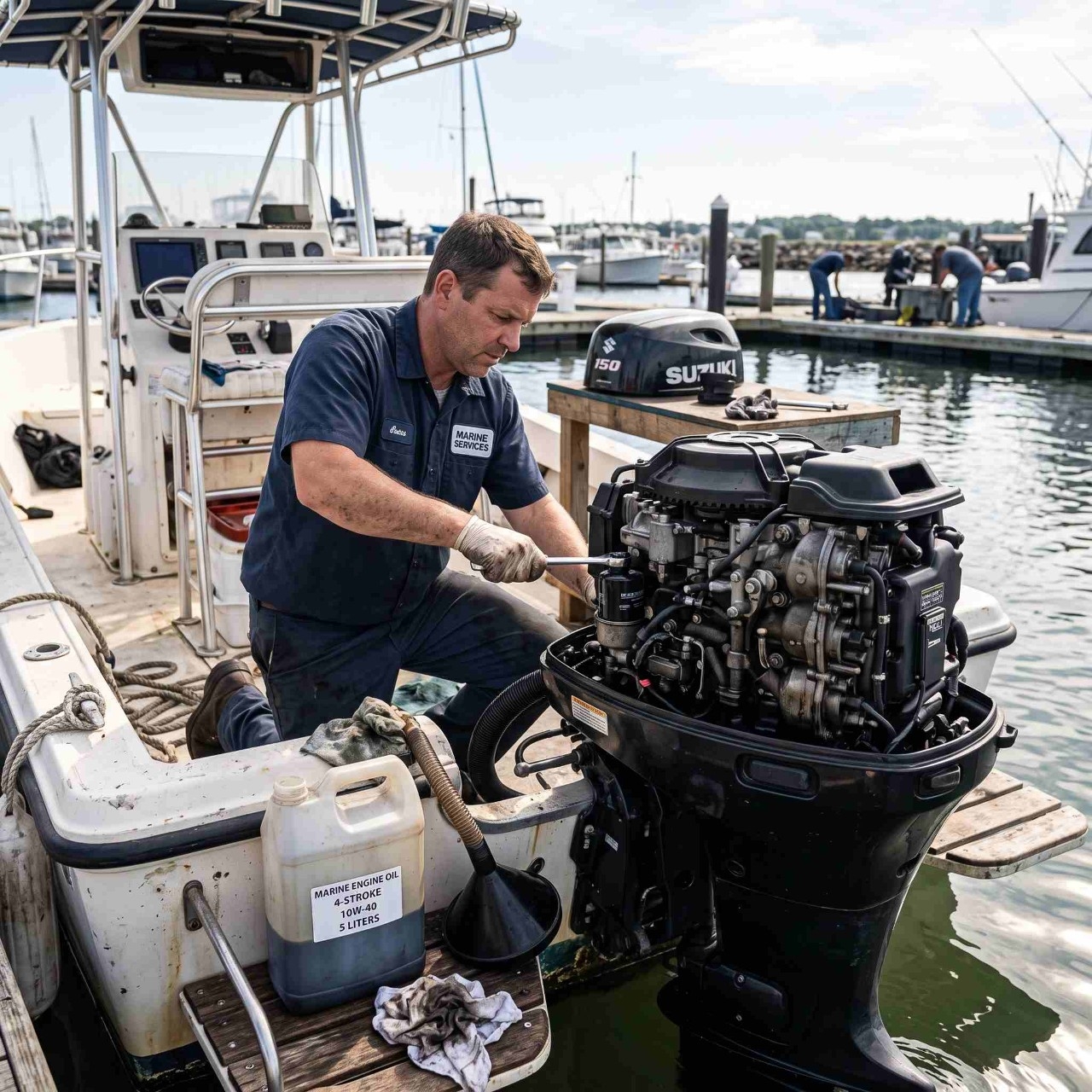
A 4-stroke outboard motor works, in essence, like the engine of a car: the oil remains in the crankcase, circulates through a pump, and must maintain its viscosity (the resistance of the fluid to flow, which determines whether it protects well both in the cold and at working temperature) throughout the interval between changes, without being degraded by heat or ambient humidity.
The reference specification in this segment is the NMMA FC-W (Four Cycle-Watercraft) standard, developed specifically for oils intended for 4-stroke marine engines. A lubricant that meets the FC-W standard has passed tests suited to the operating conditions of this type of engine, including specific requirements for corrosion protection, lubricant stability, and operation in environments with the constant presence of water and humidity, requirements different from those of a conventional automotive oil.
Recommended viscosity and resistance to salt water
Viscosity, expressed as the SAE grade (for example, 10W-30), indicates how the oil behaves in the cold (the number followed by the "W", from *winter*) and in the heat (the second number). In 4-stroke outboards, it is common to find manufacturer’s recommendations for viscosities such as 10W-30 or 10W-40, but, as in any engine, the correct viscosity is the one indicated in the manual for each model, not a generic figure valid for all outboards on the market.
Beyond viscosity, the oil of a 4-stroke marine engine needs something that a car oil is not required to provide: specific resistance to salt water. Salt is an accelerator of corrosion and can also promote the formation of foam if the oil is not formulated with anti-foaming and anti-corrosion additives designed for that environment. An oil that does not control foaming properly loses the ability to lubricate at the moment when it is most needed: at high revs and with the engine hot.
Why isn't any car or motorcycle oil suitable for a marine engine?
The answer has a lot to do with the specific demands of the marine environment, and this is where marine lubricants come into play, formulated to respond to working conditions that are very different from those of a land vehicle.
The answer has several aspects:
- The working environment is different. A marine engine is exposed to constant humidity, salt water (in sea navigation), and long periods of inactivity between uses, with the risk of internal corrosion that this implies. Car oils are not formulated or tested against those conditions.
- The standards are not equivalent. The ACEA and API automotive specifications (for gasoline or diesel) and the ILSAC standards for gasoline car engines are intended for on-road driving cycles, not for the sustained engine speed range and exposure to water typical of an outboard. A motorcycle oil, with formulations aimed at wet clutches, is also not valid for this use.
- In 2-strokes, the difference is even greater. A 2-stroke land motorcycle oil is not certified under the TC-W3 standard or tested in water cooling, so it may leave deposits or not protect the same against marine corrosion.
- The engine warranty may be at stake. Many outboard manufacturers require the use of oils approved under TC-W3 or FC-W as a condition of warranty. Using an uncertified product, even if it “seems” suitable because of its viscosity, can invalidate the coverage.
The valid reference is always the exact approval requested by the manual for that particular engine.
How often to change the oil of an outboard motor?
In a 2-stroke motor there is no “oil change” in the classic sense, because the lubricant is consumed with the fuel. What must be monitored is the level of the oil tank (if the engine has separate lubrication) and replace it with the specific oil recommended by the manufacturer before it runs out. In the case of motors that mix oil directly with gasoline, it is essential to respect the mixing ratio indicated by the manufacturer, since an excess or lack of oil can cause premature wear, excessive smoke, or even engine seizure. In addition, it is advisable to periodically check the air filter and spark plugs, as poor condition in these components can alter combustion and affect the internal lubrication of the engine.
Repsol range for recreational boats
Repsol has a wide range of lubricants specifically formulated for recreational boats, adapted to the requirements of marine engines, both outboard and inboard, two-stroke and four-stroke. These products are designed to offer effective protection against corrosion, humidity, and the variable working conditions typical of the nautical environment, ensuring optimal lubrication even at high revs and cold starts.
In addition to engine oils, the range includes specific lubricants for transmissions and other mechanical components found in boats. Having products approved and recommended by marine engine manufacturers is key to preserving the performance and extending the useful life of the machinery, minimizing the risk of breakdowns resulting from inadequate maintenance.