
Top tips

Motorcycle chain lubricant: types, how to apply and how often to grease

08 June 2026
The chain is one of the parts on a motorcycle that works the most and, at the same time, complains the loudest when it needs maintenance. Choosing the right lubricant for your motorcycle chain, applying it properly, and doing so as frequently as needed helps reduce friction, extend the useful life of the drive chain kit, and maintain a smoother response on the road.
Although sometimes we talk about oil or grease for the motorcycle chain as if they were the same thing, not all products offer the same behavior nor serve the same purpose for any use. Driving on dry roads every day is not the same as driving in rain, dust, mud, or with heavy loads.
That's why it's important to know which options exist and when each one is worth using. You can also take a look at the range of Repsol Lubricants motorcycle oils, with specific solutions for the needs of each type of rider.
Why is it so important to lubricate the motorcycle chain?
Motorcycle chain lubrication serves several functions at once.
- It reduces friction between the links, retainers, and contact with the crown wheel and pinion.
- It also helps protect against corrosion, displaces moisture, and limits accumulation of dirt when the right product is used and in the right amount.
In addition, a well-lubricated chain transmits power better and works with less effort. This means it runs more smoothly, generates less mechanical noise, and that wear takes place more evenly throughout the drive chain kit.
Consequences of not lubricating: premature wear, breakage, and danger while riding
When the chain of a motorcycle runs dry or is poorly lubricated, wear is accelerated. It may start to jerk, you may hear metallic noises, notice a certain stiffness, and a progressive loss of smoothness may begin to appear. In the medium term, the chain begins to stretch, becoming loose prematurely, and both the crown wheel and the pinion deteriorate more quickly.
In the most serious cases, the problem is no longer just one of maintenance and becomes one of safety. A chain that is very worn, badly tensioned, or that has damaged links can break or come off, with the consequential risks while riding. That is why lubricating is also about preventing breakdowns and unsafe situations.
Types of lubricant for motorcycle chains
There are different formulations on the market for the maintenance of the secondary transmission. The choice depends on the type of motorcycle, its actual use, and the conditions in which it is used.
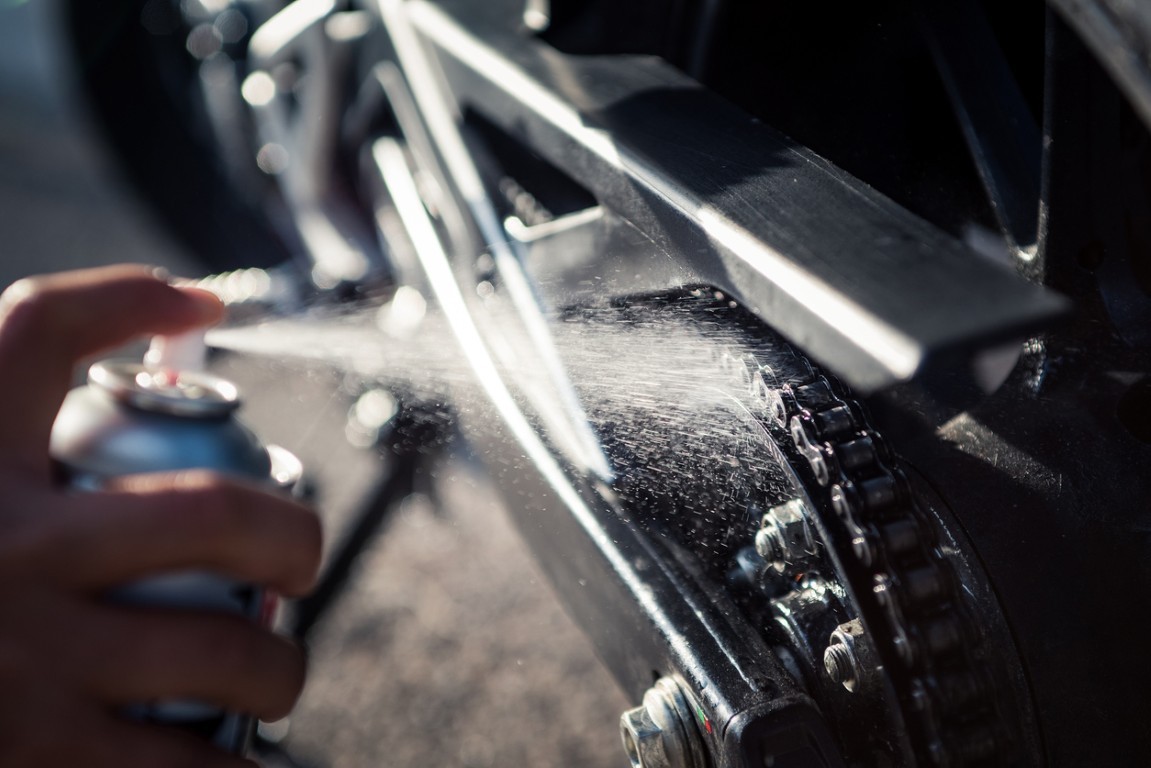
Lubricant spray: the most comfortable. When to use it?
Spray is the most common due to being the easiest to apply. It allows you to distribute the product evenly, easily access to the internal components of the chain, and perform maintenance quickly. For normal road use, daily commuting, or frequent maintenance, it is usually the most practical solution.
In addition, many sprays are formulated to offer good adhesion without leaving excessive residue. This helps keep the chain protected without turning it into a point of dirt accumulation. If you're looking for convenience and a clean app, it's usually the first choice.
Chain grease: longer lasting, ideal for intensive use and rain
Motorcycle chain grease usually offers a stronger and more durable film, which is especially useful when the motorcycle is used intensively or frequently ridden in the rain. It can also be a good alternative on long routes, as it can withstand water from washing and continuous exposure better than other options.
However, it should be applied in moderation. When more than necessary is used, the excess can trap dust, sand, or debris from the road. The key is not to grease the chain "a lot," but simply to apply a homogeneous layer that's just enough for the protection the chain needs.
Ceramic and Teflon™ lubricants: differences and when they're worthwhile
Ceramic lubricants tend to stand out for their ability to maintain a resistant film in demanding conditions, with good stability and protection against wear. On the other hand, lubricants with PTFE (better known as Teflon™) seek to reduce friction and improve slippage, something appreciated by those who prioritize a soft touch and cleanliness.
In practice, both can work well if the formulation is of quality and fits the use. They are more worthwhile when the bike is used frequently, if you want to fine-tune maintenance, or circulate in variable conditions where conventional lubrication falls short.
O-ring and X-ring chains: what lubricant to respect so as not to damage the seals
Chains with O-rings and X-rings incorporate seals that help preserve the internal grease and protect critical points. Precisely for this reason, it is important to use products compatible with these seals.
It is not advisable to apply any aggressive solvents or products not intended for motorcycle chains, as they could damage the seals over time. It is best to choose a specific chain lubricant and check that it is suitable for chains with seals. The owner's manual is the best place to look to confirm your choice.
How to apply lubricant properly
Applying a product correctly is just as important as choosing the right one. Improper application reduces the effectiveness of the lubricant and it can become excessively dirty.
In addition, it is advisable to clean the chain before greasing it to ensure that no dirt or particles remain after use. It is also important to remove water and prevent oxidation.
Apply inside, at a moderate temperature, and with the wheel turning
The ideal situation for lubricating a motorcycle chain is to do so when it is still warm, so at least going for a short ride beforehand is recommended. With a little bit of temperature, the product penetrates better and is distributed more easily. The application must be made on the inner side of the chain, which is where the centrifugal force works best for the lubricant while riding.
If the bike is on a stand, you can turn the wheel by hand, little by little, to distribute the product evenly across the entire chain. It should always be done with the engine off and carefully, avoiding any unsafe handling. Afterwards, it is advisable to let the lubricant act a few minutes before using the motorcycle.
How to remove excess lubricant so that dirt does not build up
Once applied, the chain does not need to be soaked in lubricant. In fact, excess lubricant will be counterproductive because it just ends up attracting dust and debris. It's best to wipe down the part facing out with a clean cloth to remove any excess but without eliminating the useful film.
That small difference makes quite a difference in maintenance. A chain with the right amount of product is well-protected, dirties less, and keeps running better.
Lubricant for dry weather vs. lubricant for rain
In dry weather, a cleaner and lighter lubricant that protects well without leaving an excessively sticky layer tends to work better. This helps prevent dust or fine dirt from getting stuck in the lubricant, which is very common in the summer on city or secondary roads.
When it's rainy, you wash your bike frequently, or use it in humid conditions, a formulation with more adhesion and greater water resistance is of interest. There the grease of the motorcycle chain or a lubricant specifically intended for use in wet or humid conditions usually offers better results because it takes longer to disappear and better protects against corrosion.
In other words, there is no single universal answer. The best lubricant for a motorcycle chain is the one that adapts to how and where you use the motorcycle.
How to apply lubricant properly
Applying a product correctly is just as important as choosing the right one. Improper application reduces the effectiveness of the lubricant and it can become excessively dirty.
In addition, it is advisable to clean the chain before greasing it to ensure that no dirt or particles remain after use. It is also important to remove water and prevent oxidation.
Apply inside, at a moderate temperature, and with the wheel turning
The ideal situation for lubricating a motorcycle chain is to do so when it is still warm, so at least going for a short ride beforehand is recommended. With a little bit of temperature, the product penetrates better and is distributed more easily. The application must be made on the inner side of the chain, which is where the centrifugal force works best for the lubricant while riding.
If the bike is on a stand, you can turn the wheel by hand, little by little, to distribute the product evenly across the entire chain. It should always be done with the engine off and carefully, avoiding any unsafe handling. Afterwards, it is advisable to let the lubricant act a few minutes before using the motorcycle.
How to remove excess lubricant so that dirt does not build up
Once applied, the chain does not need to be soaked in lubricant. In fact, excess lubricant will be counterproductive because it just ends up attracting dust and debris. It's best to wipe down the part facing out with a clean cloth to remove any excess but without eliminating the useful film.
That small difference makes quite a difference in maintenance. A chain with the right amount of product is well-protected, dirties less, and keeps running better.
Lubricant for dry weather vs. lubricant for rain
In dry weather, a cleaner and lighter lubricant that protects well without leaving an excessively sticky layer tends to work better. This helps prevent dust or fine dirt from getting stuck in the lubricant, which is very common in the summer on city or secondary roads.
When it's rainy, you wash your bike frequently, or use it in humid conditions, a formulation with more adhesion and greater water resistance is of interest. There the grease of the motorcycle chain or a lubricant specifically intended for use in wet or humid conditions usually offers better results because it takes longer to disappear and better protects against corrosion.
In other words, there is no single universal answer. The best lubricant for a motorcycle chain is the one that adapts to how and where you use the motorcycle.
How often should the chain be greased?
There is no single frequency valid for all motorcycles, because the type of chain, the weather, the state of the road and the product used all have an influence. Even so, there are useful guide ranges so as not to neglect maintenance. Again, always refer to the owner's manual to follow their maintenance instructions.
In normal road use, a reasonable reference is to lubricate the chain every 500 to 1,000 kilometers. If the motorcycle has ridden in heavy rain, passed through very humid areas, or has been washed recently, it is advisable to check and lubricate again before stopping the motorcycle, even if that mileage has not been reached.
It is also worth performing maintenance in advance if you notice that the chain is drier, makes noise, has a rough touch or dirt is visible. Waiting too long is often more expensive than spending a few minutes on the issue before it gets worse.
Signs that the chain needs replacing and not just lubrication
There are times when the problem can't be solved with more lubricant. If the motorcycle chain has hard spots, certain sections are looser than the rest, blocked-up links, obvious rust, or excessive stretching, it is very likely that the transmission kit is near the end of its useful life.
It is also advisable to check the condition of the crown wheel and pinion. If the teeth appear very sharp, deformed or inclined, it is not enough to just grease them. In that case, the best thing to do is replace the entire assembly to avoid uneven wear and ensure safe operation.
Automatic chain lubrication systems and how they work
Automatic lubrication of the motorcycle chain is a system designed to dispense small amounts of lubricant continuously or periodically while the motorcycle is on the road. Its goal is to keep the chain protected without relying on very frequent manual application.
In general, these systems work by means of a small tank and a conduit that carries the lubricant to the chain. Some are mechanical, others electronic, and others are regulated by depression or flow. Properly adjusted, they help improve maintenance consistency and can extend the useful life of the transmission, especially on motorcycles that rack up a lot of road time.
Now, this doesn't eliminate the need for revisions. Even if the automatic lubrication of the motorcycle chain reduces the frequency of intervention, it is still necessary to check tension, cleanliness, wear, and general condition of the drive chain kit.
Frequently asked questions about lubricant in motorcycle chains
How often should a motorcycle chain be lubricated?
As a general guideline, every 500 to 1,000 km in road use. If it has rained, you've washed your motorcycle, or you ride in areas with dust or mud, it's a good idea to check beforehand. Rather than focusing only on mileage, it is important to observe the actual state of the chain.
Which lubricant is best for the motorcycle chain when it rains?
When there is rain or high humidity, a lubricant with high adhesion and good water resistance usually works better. In this scenario, a greasier formulation or a specific lubricant for wet conditions protects longer and reduces the risk of corrosion.
Can motor oil be used to lubricate the chain of a motorcycle?
This isn't recommended. Although motor oil is sometimes used as an improvised solution, it isn't specifically formulated to adhere to the chain or to protect it from spinning, water, or dirt. The best thing is to use a specific lubricant for motorcycle chains and compatible with O-ring or X-ring seals, if applicable. And for the maintenance of the engine itself, avoid the most common mistakes when changing your motorcycle's oil.
How do you clean a motorcycle chain before lubricating it?
It is appropriate to first remove dirt with a specific cleaner for chains or a product compatible with seals, using a soft brush. Then, dry it well and apply the lubricant to the clean chain. Lubricating on dirt only spreads residues and worsens the result.
Does automatic chain lubrication replace manual maintenance?
Not completely. It helps a great deal to keep lubrication constant, but it does not replace cleaning, checking for wear, or tension adjustment. It is a very useful aid, but not a complete replacement for maintenance.
Related contents

Rally Morocco 2026
Discover how the Rally Morocco went and the participation of the Repsol Toyota Rally Team.
Show more
07 October 2026
0W-20 or 5W-30 oil: which one does your car use?
We explain why modern engines increasingly require lower-viscosity oils, such as 0W-20, and when it's best not to push the limits.
Show more
06 October 2026
Two-stroke motorcycle oil mixture
We explain the common oil-to-gasoline mix ratios for 2-stroke motorcycles and how to prepare it properly.
Show more
01 October 2026