
Top tips

Types of lubricating greases: complete guide by composition and use
19 August 2026
Not all lubricating greases are the same or can be used interchangeably. Their performance depends on the combination of the base oil, the thickener, and the additives, but also on their consistency and the working conditions of the equipment.
When choosing among the different types of lubricating greases, it is necessary to consider variables such as temperature, the presence of water or contaminants, the speed of the components, load, vibrations and the application system. A grease suitable for an industrial bearing may not be the best choice for agricultural machinery joints or an automotive components.
In this guide, we explain how greases are classified by their thickener, what the NLGI grade means, and what their most common applications are. These guidelines are for reference only: final selection should always be based on the equipment manual and manufacturer specifications.
What is a lubricating grease and how does it differ from an oil?
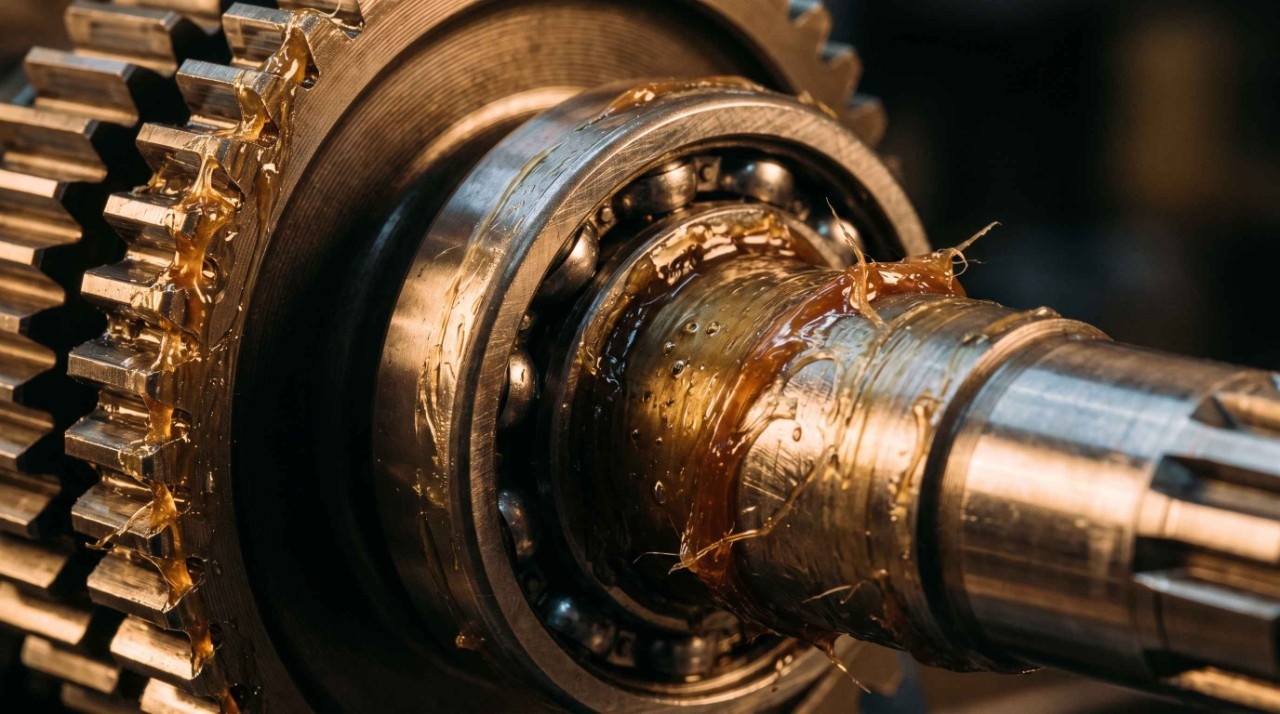
A lubricating grease is a semi-fluid product designed to reduce friction, protect surfaces, and remain at the point of application for an extended period.
Its formulation consists of three main components:
- Base oil: the primary component responsible for lubrication. It can be mineral, synthetic or of other types depending on the formulation.
- Thickener: creates a structure that retains the oil and provides consistency to the grease.
- Additives: improve specific properties such as protection against wear, oxidation, corrosion, or high loads.
The thickener does not lubricate by itself; instead, it acts as a "mesh" that holds the oil inside and gradually releases it during operation.
This structure is the main difference compared to a lubricating oil. While oil is designed to circulate through systems, pipes or circuits, grease is meant to remain at the point of contact.
|
Feature |
Lubricating grease |
Lubricating oil |
|
Consistency |
semifluid or solid |
Liquid |
|
Retention |
High. |
It depends on the system |
|
Circulation |
Limited |
Continuous |
|
Heat dissipation |
Reduced |
High |
|
Sealing |
High |
Low |
|
Typical application |
Bearings, joints |
Engines, transmissions |
Grease is especially useful when the lubricant must remain in a specific area, when access is difficult, or when additional protection against contaminants is required. Oil, on the other hand, is more suitable when cooling, circulation, or filtration is required.
They are not interchangeable products: their use depends on the design of the equipment.
Classification of lubricating greases according to their thickener
One of the most common criteria for classifying lubricating greases is the type of thickener. This element influences behavior in the presence of water, mechanical stability and temperature resistance.
There are organometallic thickeners (such as lithium, calcium, or aluminum) and non-metallic thickeners (such as polyurea). However, the thickener itself does not determine grease performance.
Before choosing a product, it is advisable to review:
- Type of thickener.
- Viscosity of the base oil.
- NLGI grade.
- Temperature range.
- Water resistance.
- Mechanical stability.
- Load capacity.
- Operating speed.
- Manufacturer's specifications.
Compatibility between greases is also important. Mixing different products can alter their structure, reduce their stability, or affect their lubricating capacity. In some cases, it is necessary to clean the system before changing products.
Lithium greases: the most widely used in the automotive and industrial sectors
Lithium greases are among the most widely used due to their balance of performance and versatility. They usually offer good mechanical stability, adhesion, and water resistance in a wide range of applications.
They are commonly used in:
- Bearings.
- Joints.
- Chassis.
- Industrial equipment.
- Automotive components.
Within this family there are two main variants:
- Conventional lithium greases: suitable for general applications.
- Complex lithium greases: designed to improve performance at higher temperatures or in more demanding conditions.
Not all lithium greases are created equal. Their performance also depends on the base oil, additives and NLGI grade.
Before using them, it is essential to check the compatibility with the equipment, the operating temperature, and the base oil viscosity.
Calcium and calcium sulfonate greases: water resistance
Calcium greases stand out for their good water washout resistance, making them useful in humid environments or exposed to the elements.
They are used in:
- Agricultural machinery.
- Outdoor equipment.
- Chassis and joints.
- Water splash applications.
- Marine or industrial environments.
Calcium sulfonate complex greases can offer, in certain formulations, a combination of water resistance, corrosion protection, and high load capacity.
However, these properties depend on the complete formulation. Not all calcium or calcium sulfonate greases behave the same.
Furthermore, water resistance does not mean that they are suitable for any bearing or system. Speed, temperature, and load should also be considered.
Polyurea and aluminum complex greases: high-temperature and long-life
Polyurea greases use non-metallic thickeners and can offer good oxidation stability and a long service life in certain applications.
They are frequently used in:
- Electric motors.
- Long-lasting bearings.
- Low-maintenance applications.
Their performance depends on the complete formulation, not just the thickener.
Aluminum complex greases can offer good adhesion, stability, and water resistance in certain industrial applications. Some formulations may also be designed for specific sectors, provided that they meet the corresponding technical requirements.
Mixing incompatible greases can cause:
- Softening or hardening.
- Oil separation.
- Loss of stability.
- Reduction in protection.
- Pumping issues.
Therefore, before changing grease, it is advisable to consult compatibilities and follow an appropriate replacement procedure.
NLGI Grades: how to choose the right consistency
The NLGI system classifies greases according to their consistency, i.e., their degree of hardness or fluidity.
Generally speaking:
- NLGI 000 to 0: very fluid or semi-fluid.
- NLGI 1 to 2: medium consistency, the most common.
- NLGI 3 or higher: firmer greases.
The NLGI grade does not indicate quality or performance, only consistency. Two NLGI 2 greases can behave very differently depending on their formulation.
The choice depends on:
- Equipment design.
- Application method.
- Operating speed.
- Temperature.
- Load.
- Vibrations.
- Sealing requirements.
- Lubrication system.
A grease that is too soft can be displaced from the application point, while one that is too hard can hinder proper lubrication.
Types of lubricating greases according to their application
In addition to their composition, greases are classified according to their use in different sectors. This classification helps guide selection, although it is not a substitute for technical analysis.
Automotive, agricultural, and industrial greases
- Automotive: They are used in bearings, joints, and chassis components. They must offer wear resistance, mechanical stability, and protection against moisture and vibrations.
- Agricultural machinery: They operate under demanding conditions: dust, mud, water, and load fluctuations. Water resistance, adhesion, and corrosion protection are especially valued.
- Industry: It includes a wide variety of equipment. Selection depends on speed, temperature, load, the presence of contaminants, and the lubrication system.
Biodegradable greases for sensitive environments
Biodegradable greases are designed to reduce their environmental impact in the event of accidental leakage. They are used in:
- Agriculture.
- Forestry.
- Marine environments.
- Hydraulic works.
- Protected areas.
Biodegradability depends on the complete formulation, not just the base oil. Furthermore, this does not mean that the product can be disposed of uncontrollably.
They must also meet the technical requirements of the equipment, as environmental protection is not a substitute for mechanical performance.
The Repsol grease range for each sector
Repsol's range of greases is designed to meet needs in the automotive, industrial, and agricultural sectors. Choosing the right product should be based on actual working conditions and the equipment manufacturer's specifications.
In the automotive sector, stability, wear protection, and moisture resistance are prioritised. In industry, speed, load, and temperature are key factors. In agriculture, water resistance, corrosion protection, and the ability to operate in environments with dirt or dust stand out.
When selecting a grease, it is advisable to review:
- Type of thickener.
- NLGI grade.
- Viscosity of the base oil.
- Operating temperature.
- Load and speed.
- Presence of contaminants.
- Application method.
- Compatibility with existing greases.
- Manufacturer's specifications.
The different types of lubricating greases are differentiated by their composition, consistency, and application. There is no universal grease: each piece of equipment requires a product adapted to its operating conditions.
Choosing correctly involves analyzing the environment, load, temperature, speed, and compatibility with other lubricants. To ensure equipment performance and protection, the manufacturer's recommendations and the product technical data sheet must always be followed.