
Top tips

Protecting motorcycle chains and transmissions: tips to extend their useful life
05 May 2026
Your motorcycle's chain and transmission work silently, but their role is decisive every time you take it out for a ride. They are responsible for transmitting the engine's power to the wheel and therefore have a direct influence on response, running smoothly, and safety. It's the reason why good maintenance of these elements goes beyond avoiding breakdowns or premature wear and makes a difference in your feel of the bike when riding.
Dust, water, mud, temperature changes, and poor lubrication can all accelerate chain and transmission deterioration much sooner than expected. That's why spending a few minutes on maintenance can mean more reliability, fewer worries, and a longer lifespan for the entire transmission system.
Why it's important to protect your motorcycle's chain and transmission
A motorcycle's final drive is subjected to constant stress. Every acceleration, every change of pace, and every ride under harsh conditions puts the chain, sprocket, and crown wheel to the test. When this system is well cared for, the bike responds better, transmits power more efficiently, and reduces the risk of uneven wear.
On the other hand, a chain that is dirty, not at the optimal tension, that that is not using the right lubricant generates more friction than necessary. That friction translates into noise, loss of smoothness, increased wear on the drag kit teeth, and less corrosion protection. What starts as a small lack of maintenance can end up affecting your bike's overall performance.
What causes motorcycle chain wear?
One of a chain's main enemies is dirt. Dust, sand, or bits of mud stick to the surface and act as an abrasive that punishes link after link. On top of this, moisture or rain can displace the lubricating film and lead to oxidation.
Improper tension also plays a role. If the chain is too tight, this forces bearings, seals, and shafts. If it has too much slack, bumps, tugs, and uneven wear appear. So, in addition to lubricating, it's a good idea to periodically check the chain and adjust if necessary, always following the manufacturer's instructions.
Another common mistake is to use non-specific products. Not all lubricants work for a motorcycle chain. Choosing a product formulated for this use helps protect against wear, improve adhesion, and prevent lubrication from disappearing too soon.
How to properly clean and lubricate a motorcycle chain
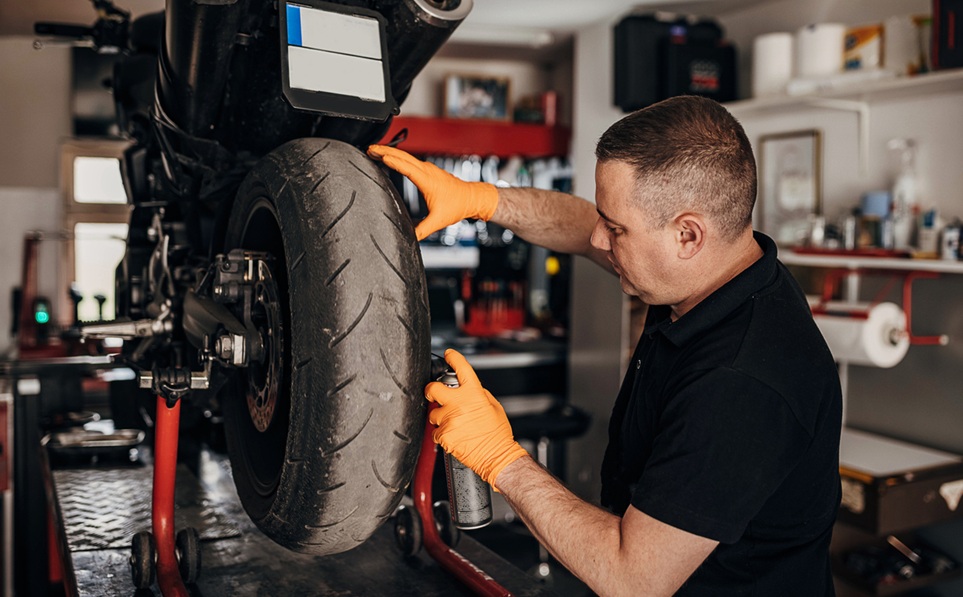
The first step in extending the chain's lifespan is to keep it clean. Before applying lubricant, remove the accumulated dirt with a specific product and a suitable brush. This prevents dirt and filth from getting trapped and further damaging the assembly.
Then comes the lubrication. Ideally, it should be applied when the chain is clean and, if possible, slightly warm after moderate use. This helps the product spread across all of the chain's surface. Lubricant must be applied uniformly, paying attention to the entire length of the chain and taking care to not apply excess product. Too much lubricant does not improve protection; rather, it can attract more dirt.
It is also important to let the lubricant act before using the motorcycle again. This rest time helps the protective film settle and do its job when the real demand arrives: accelerations, rain, heat, or kilometers of road.
How often should maintenance be performed?
There is no single recommendation for all motorcycles and all uses, but there is a clear rule everyone can follow: the harsher the conditions, the more attention the chain needs. In normal road use, checking and lubricating the chain every few kilometers helps keep it in good condition. If you frequently ride your motorcycle in the rain, in dusty areas, on dirt roads, or after a wash, it is advisable to perform maintenance every time you use your motorcycle.
Rather than waiting for the problem to appear, the key lies in anticipation. A well cared-for chain is an element of your bike that you can depend on. The bike will sound better, respond better, and run smoothly every time you ride.
Signs that your transmission needs to be checked
The bike itself usually lets you know when something isn't going as it should. If you notice metallic sounds, sudden jerks when accelerating, unusual vibrations or it feels rough while running, it is advisable to check the chain's condition as well as the rest of the drive kit.
It's also important to see how it looks. The presence of rust, suck links, uneven tension, or visibly worn teeth on the crown or pinion are clear signs that maintenance can't be postponed for any longer. In these cases, acting quickly can prevent further damage and unnecessary costs.
Which chain and transmission lubricant to choose
Choosing the right lubricants for your motorcycle's chain is an essential part of maintenance. A good product should help reduce friction, protect against moisture, withstand work in demanding conditions and remain adherent without compromising the cleanliness of the assembly. Thus, protection lasts longer and performance remains more stable between revisions.
At Repsol Lubricants, we understand maintenance as a way to take care of what is not visible to the naked eye, but is still noticeable every time you ride. This is why we have a lubricant search engine for you to use: simply type in your motorcycle's model and you'll find all the ideal products for it.
Because when the transmission is well cared for, everything runs better: your bike responds accurately, wear is reduced, and each ride is experienced with that peace of mind that only comes from knowing that your bike is all set to keep riding.
Related content
Mineral vs Synthetic vs Semi-synthetic oil
Discover the differences between mineral, semi-synthetic, and synthetic oil, their pros, and which one to choose for your engine and driving style.
Show more
15 October 2026
Motorcycle coolant: water or specific liquid
Here's why water or a generic antifreeze does not protect like a motorcycle-specific coolant.
Show more
13 October 2026
Rally Morocco 2026
Discover how the Rally Morocco went and the participation of the Repsol Toyota Rally Team.
Show more
07 October 2026