
Top tips

ACEA C2 vs C3: the differences and which one your car needs
29 September 2026
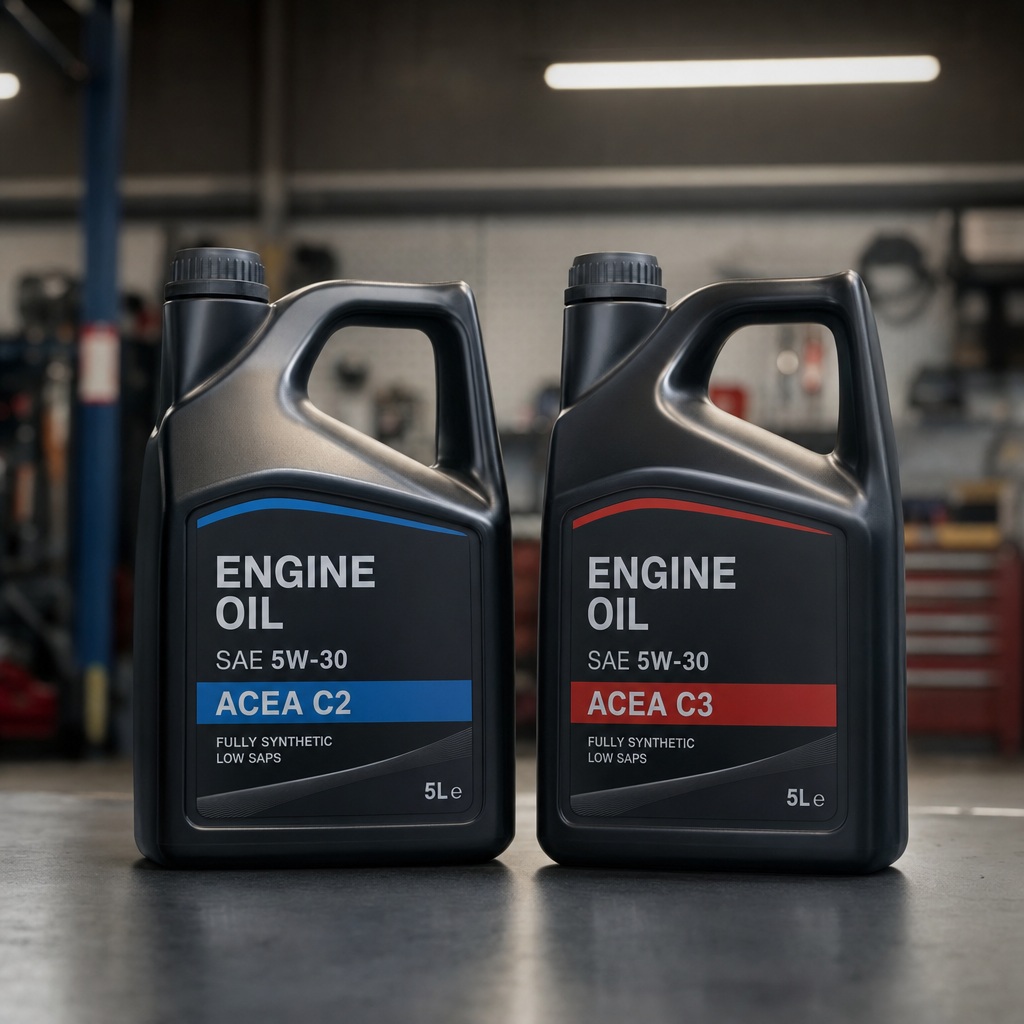
ACEA C2 and ACEA C3 oil share a family — both are "mid SAPS", compatible with the particulate filter — but they are not simply interchangeable: they differ in the thickness of the hot lubricating film (HTHS) and in the design approach, the one being more oriented to fuel economy and the other to mechanical protection. In this technical guide, we explain what they share, how they differ. and how to know which one your engine really needs, within the wide range of car oils offered by Repsol.
Confusing these two categories is not a minor nuance. An error in the ACEA standard can result in an engine that does not lubricate well under demanding operating conditions. At Repsol Lubricants, we work routinely with workshops and manufacturers, and this, together with confusion between the SAE grade and ACEA standard, is one of the technical questions that is most repeated in the sector.
What do ACEA C2 and C3 (both Mid-SAPS) have in common?
Before talking about the differences, it is advisable to establish what ACEA C2 and ACEA C3 have in common, precisely because this is what creates confusion.
The ACEA (Association des Constructeurs Européens d'Automobiles) is the association of European manufacturers that publishes, together with the manufacturers themselves, the reference classification for motor oils in Europe. Within that classification, category C (C2, C3, C4, C5, C6...) groups together the oils designed for vehicles equipped with exhaust gas after-treatment systems: diesel particulate filter (DPF), gasoline particulate filter (GPF), and three-way catalysts.
C2 and C3 share two essential traits:
- They are both "Mid SAPS" (*Mid-level Sulfated Ash, Phosphorus, Sulfur*). This means that their content of these elements is limited, although not as drastically as the more restrictive “Low SAPS” (category C4). The goal is the same: to reduce the risk of clogging and damage to the particulate filter and catalyst over the lifetime of the vehicle.
- Both are suitable for vehicles with DPF/GPF, unlike category A/B oils (intended for engines without these systems), which may contain additivation levels incompatible with them.
The difference between the two categories is not, therefore, their compatibility with the particle filter —both have it— but another parameter that we will look at below: the HTHS.
Comparison table: ACEA C2 and C3 (HTHS, fuel economy, protection)
The parameter that really separates C2 from C3 is the HTHS (*High Temperature High Shear*), the viscosity of the oil measured under conditions of high temperature and high shear, that is, the actual thickness of the lubricating film when the engine works under the most demanding conditions (high revolutions, components with high friction such as bearings or cams). We already explained it in detail in our article on the HTHS viscosity of oil.
ACEA C2 oil has a lower HTHS, designed to minimize internal friction and promote fuel economy, while ACEA C3 has a higher HTHS, prioritizing the thickness of the lubricating film and, therefore, mechanical protection in demanding conditions. This difference in approach is also reflected in the formulation of references such as those in the Elite range, designed to offer a high level of protection in engines that require a more robust film.
Below is a brief comparison of the main differences between the two specifications:
|
Feature |
ACEA C2 |
ACEA C3 |
|
HTHS (mPa·s) |
Lower (≥ 2.9) |
Higher (≥ 3.5) |
|
Main focus |
Fuel efficiency |
Mechanical protection |
|
Thickness of the lubricant film |
Lower |
Higher |
|
Internal friction |
Reduced |
Moderate |
|
Suitability |
Engines designed for low friction and low emissions |
Demanding or high-performance engines |
However, some SAE 5W-30 oils may simultaneously meet ACEA C2 and C3. Formulated around the HTHS limit of 3.5 mPa·s and after passing the tests of both categories, they combine energy efficiency with high protection against wear.
Which cars need ACEA C2?
The ACEA C2 specification is intended for modern engines specifically designed to run on low-friction lubricants (midSAPS* and low HTHS viscosity), with the aim of reducing fuel consumption and emissions.
Therefore, vehicles equipped with sensitive gas after-treatment systems, such as a diesel particulate filter (FAP/DPF) or three-way catalysts, usually require a C2 oil, since this type of oil helps protect these components thanks to its low content of sulfated ash, phosphorus and sulfur (known as the *low SAPS* specification). In addition, its minimum HTHS viscosity of 2.9 mPa·s permits a reduction in the internal friction of the engine without compromising the protection needed at high temperatures, which contributes to improving the energy efficiency of the vehicle.
In the Repsol catalog, some lubricants are formulated precisely for this type of engines to prioritize efficiency, protection of the anti-pollution systems, and compliance with the most demanding emissions regulations.

Which cars need ACEA C3?
The ACEA C3 specification is common to a large number of European vehicles, especially those equipped with diesel particulate filter (DPF) engines and gasoline engines with more advanced emission control systems. Manufacturers such as Volkswagen, Mercedes-Benz, BMW, Audi, Ford, Opel, and Fiat, among others, include references to this category in their maintenance manuals, either directly or through their own specifications based on it (such as VW 504.00/507.00, MB 229.51 or BMW LL-04).
Why does the 5W30 viscosity not determine the ACEA standard?
5W30 viscosity only indicates how an oil behaves in response to temperature: how it flows in the cold (5W) and how it behaves at the operating temperature of the engine (30). This datum corresponds to the SAE classification, but it does not provide information on the chemical composition of the lubricant, its detergency level, its compatibility with gas after-treatment systems, or its suitability for specific gasoline or diesel engines.
Therefore, the same viscosity grade, such as 5W30, can be found in oils approved under different ACEA standards (for example, A3/B4, C2, and C3), each designed for different engine and compatibility requirements. The ACEA standard, and not the viscosity, helps to ensure that the oil meets the performance, protection, and compatibility requirements demanded by the vehicle manufacturer.
For this reason, it is essential to always consult the vehicle manual or the manufacturer's recommendations before choosing the right lubricant, since an ACEA C3 oil is not interchangeable with other viscosity or composition profiles without first checking its compatibility.
Can C2 and C3 oils be mixed, or can C3 be used if the manual calls for C2?
Although both belong to the same category of oils (midSAPS) compatible with exhaust gas after-treatment systems, profiles C2 and C3 are not equivalent or interchangeable without other criteria. The main difference lies in the HTHS (High Temperature High Shear) viscosity and the degree of friction for which each oil has been designed: C2’s tend to have a lower HTHS viscosity, oriented to engines that prioritize fuel efficiency, while C3’s offer greater lubricating film robustness.
In general, it is not recommended to mix C2 and C3 oils, as their formulations meet different technical requirements and doing so could alter the performance of the lubricant in the engine. Similarly, using a C3 oil in an engine that the manufacturer specifies as C2 is also not a decision that should be made without further ado: although in some cases it may be technically accepted, it is essential to confirm it in the vehicle manual or by consulting directly with the manufacturer, since engine design tolerances —especially regarding internal friction and fuel consumption— may be affected.
How to read the ACEA and the manufacturer's approval on the label
When we look at the packaging of an oil, we usually find two types of references that should be differentiated. On the one hand, the ACEA specification (for example, ACEA A3/B4 or ACEA C3), which indicates the quality level and general properties of the lubricant according to European standards. On the other hand, the specific approvals of vehicle manufacturers (such as MB-Approval, VW, BMW Longlife, etc.), which certify that that particular oil has passed the tests required by that brand for its engines.
It is important to understand that complying with an ACEA specification does not automatically imply having the approval of a specific manufacturer: they are two different levels of requirement. The ACEA sets a minimum quality standard recognized throughout Europe, while the manufacturer's approval is more restrictive and specific, adapted to the technical features of its engines. Therefore, the oil label usually shows both data independently, and it is advisable to verify that the chosen product complies with the exact approval indicated in the vehicle's manual, and not only the general ACEA classification.
Repsol ACEA C3 approved oils (Elite Evolution C3 5W-40)
Within Repsol's range of lubricants, Elite Evolution C3 5W-40 is a synthetic oil formulated specifically to meet the ACEA C3 specification, designed for gasoline and diesel engines equipped with exhaust gas after-treatment systems, such as particulate filters (DPF) and three-way catalysts.
It has a low sulfated ash, phosphorus, and sulfur content, to protect after-treatment systems and help extend their service life. In addition, it has the correct HTHS (high temperature and high shear viscosity) level to ensure the mechanical protection of the engine in demanding conditions.
This oil is especially recommended for vehicles that expressly require ACEA C3 specifications, as is common in many models from manufacturers such as Volkswagen, Mercedes-Benz or BMW. However, as indicated below, it is always advisable to verify its compatibility with the manufacturer's recommendations before proceeding to use this oil.
In short, if you have any questions about the compatibility between ACEA specifications, it is safest to go to the official vehicle documentation or to a qualified professional before making any changes to the original recommended oil.