
Top tips

How much does it cost to change the car's oil? Average price and how often to do it
08 September 2026
The cost of an oil and filter change depends on the type of oil, engine displacement, and shop labor rates, and can vary significantly from vehicle to vehicle. In this guide, we break down what goes into that cost, how often you should get an oil change, and your options for getting it done.
An oil change is one of the most common - and most important - maintenance tasks for any vehicle, but it’s also one that raises the most questions when it comes to budgeting. There is no single cost for every car: the final cost depends on the viscosity grade (identified by SAE rating, such as 5W-30), whether the oil is conventional, semi-synthetic or synthetic, the car’s oil capacity, and the labor rates of each repair shop or dealership.
At Repsol Lubricants we work with repair shops, dealerships and fleets to offer a range of oils suitable for every engine type and application, giving us a clear understanding of the factors that drive the final price paid by the driver. Below, we break down how that total cost is calculated and what you should keep in mind before deciding where and when to get an oil change. If you want to find a nearby location, you can find your nearest store.
What's included in the price of an oil and filter change
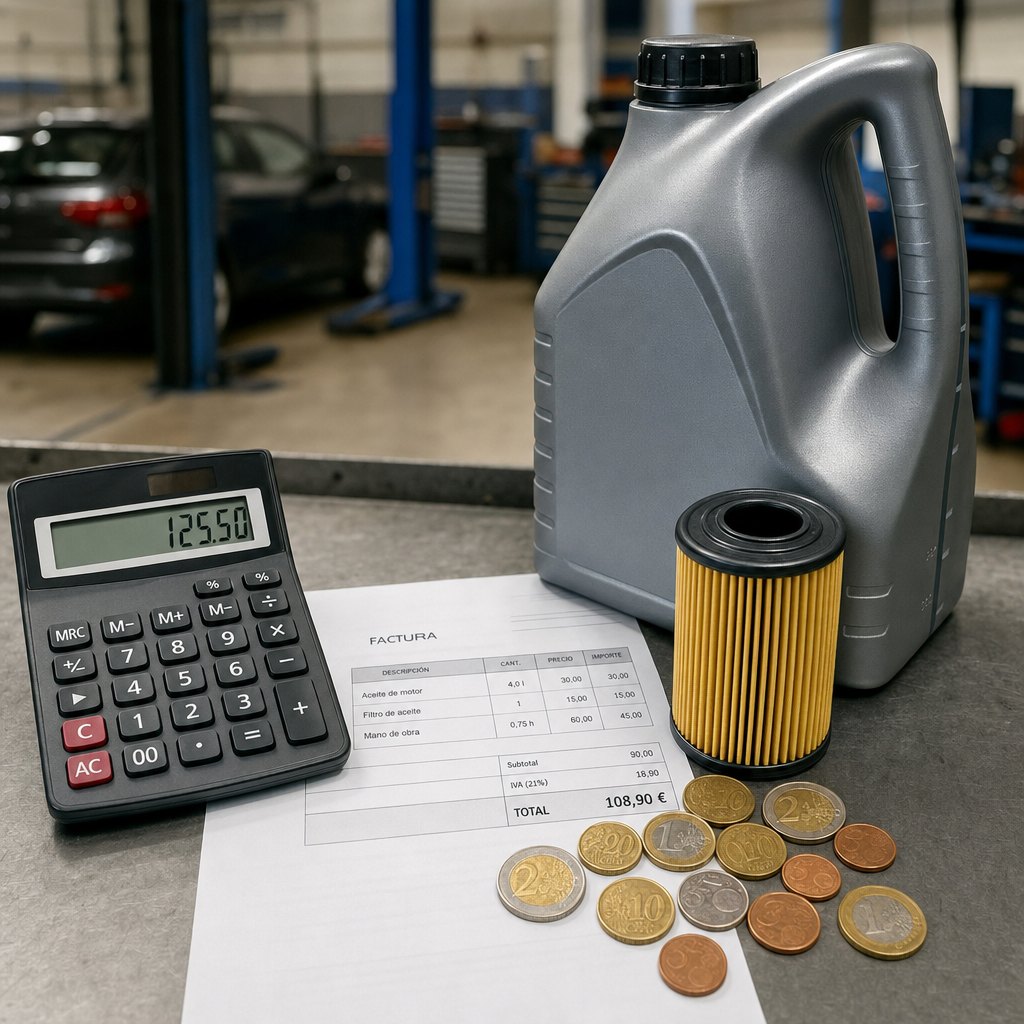
The cost of an oil change isn’t just the price of the oil in the container. A repair shop’s final invoice usually includes at least three items: the oil (by liter, depending on the amount required by the engine), the oil filter (a component that traps particles and impurities generated during combustion and must be replaced with every oil changed) and labor. In some cases, the drain plug gasket or sealing washer is also added, and authorized dealerships may include a visual check of other fluid levels (coolant, brake fluid) at no extra charge.
Labor
Labor costs vary based on the type of shop and how difficult it is to access the engine. Overall, changing the oil is a relatively quick job -taking between 20 and 40 minutes in a repair shop with a lift-, so its cost is usually lower than that of more complex mechanical repairs. Even so, hourly labor rates can vary between independent repair shops, authorized dealerships, and quick-lube centers, as well as by region or city. Authorized dealerships often charge higher rates, partly because they guarantee the use of manufacturer-approved oil and ensure the service is logged in the vehicle’s maintenance history.
Oil type and capacity
The second major factor in the cost is the oil itself: how many liters the engine requires, and the type of oil used. A small gasoline engine may require between 3.5 and 4.5 liters, whereas a larger-displacement diesel or a turbodiesel with extra components may need 5 liters or more. The exact capacity always depends on the manufacturer and should be checked in the vehicle manual or via the dipstick/oil level sensor. For the same volume, prices also vary based on whether the oil is conventional, semi-synthetic, or synthetic. Synthetic oil feature more advanced additives and higher thermal stability, so they usually carry a higher price per liter; however, they offer longer drain intervals and superior protection during harsh cold starts or high temperatures. If you want to compare options and choose the right one for your vehicle, you can check out the full range of Repsol car engine oils.
Estimated price table by oil type
Actual prices vary by make, model, engine type, and location, so any figure should be taken as a rough guide and confirmed with your repair shop’s quote. As a guide to the cost breakdow:
|
Type of oil |
Approximate liters |
Oil Price |
Labor |
Estimated total |
|
Conventional |
4-5 L |
€25-45 |
€30-50 |
€55-95 |
|
Semi-synthetic |
4-5 L |
€35-70 |
€30-50 |
€65-120 |
|
Synthetic |
4-5 L |
€50-120 |
€30-50 |
€80-170 |
As a general rule, conventional oil is usually the most economical option per liter, semi-synthetic falls in between, and synthetic oil has the highest unit price, though not necessarily the highest annual cost if it allows for longer intervals between oil changes. To find out which product range fits your vehicle, you can check the Repsol Lubricants car oil catalog, where you can filter by model and engine type.
How often should the car's oil be changed?
There is no single rule for all vehicles: the change frequency depends on the manufacturer, engine technology and real-world driving conditions. The only reliable guide is the manufacturer's maintenance manual, which specifies the approved interval for each engine and oil type. When it comes to engine lubrication, there are no shortcuts: following those recommendations is the best way to ensure the engine gets the protection it was designed for.
Based on mileage or time
The engine oil must be changed following two criteria that work together: the mileage traveled, and the time elapsed since the last change. Even if the vehicle has hardly been used, the oil degrades over time due to oxidation and exposure to moisture, so it's not enough to just look at the mileage. Generally, it is recommended to check the manufacturer's manual, since each model and each type of oil (mineral, semi-synthetic or synthetic) has specific change intervals. In any case, the rule that must prevail is "whichever comes first": if the mileage limit is reached before the stipulated time elapses, the oil must be changed; and if the specified number of months passes without reaching the indicated mileage, it will also need to be replaced. Following this dual criterion is key to ensuring optimal lubrication and extending engine’s service life.
According to the type of driving
Driving style and vehicle operating conditions directly affect oil degradation and, therefore, how often it should be changed.
- Short-distance urban driving: Frequent cold starts, and short trips prevent the engine from reaching its optimal operating temperature, which promotes the accumulation of condensation and residue in the oil. In these cases, it is advisable to shorten the change intervals.
- Driving on highways or open roads at a constant speed: by keeping the engine under stable conditions for longer, the oil degrades more slowly, so the interval recommended by the manufacturer can be extended further.
- Demanding or sporty driving: high RPMs, sudden braking and acceleration, or towing a trailer subject the oil to greater thermal and mechanical stress, making it advisable to shorten the period between changes.
- Driving in extreme climates: both intense cold and high heat affect oil viscosity and can accelerate its degradation, so special attention should be paid to these conditions.
What happens if you delay changing the oil
Delaying an oil change, even by a short time or distance, can have serious consequences for engine health. Over time, the oil progressively loses its lubricating properties and accumulates contaminants, reducing its ability to protect the engine’s moving parts.
Among the main risks of postponing this maintenance are:
- Increased friction and wear: degraded oil does not lubricate properly, which increases friction between metal parts and accelerates wear.
- Engine overheating: the oil also acts as a coolant, helping to dissipate the heat generated by combustion. If it loses effectiveness, the engine can reach higher temperatures than usual.
- Residue accumulation: over time, used oil promotes the formation of sludge and deposits that can clog oil passages.
- Reduced performance and higher fuel consumption: A poorly lubricated engine works harder, which can result in higher fuel consumption and a loss of power.
- Serious and costly breakdowns: In extreme cases, a prolonged delay can lead to permanent engine damage, with repairs that are usually much more expensive than the oil change itself.
Therefore, it is advisable not to exceed the change intervals established by the manufacturer and, if in doubt, consult with a professional to assess the condition of the oil and the engine.
Where to change your oil: repair shop, dealership or on your own
When it comes to oil changes, there are several options, each with its advantages depending on the type of driver and vehicle.
· Official dealership: This is the recommended option during the vehicle’s warranty period, as manufacturer-approved parts and lubricants are used, and the service is recorded in the car’s official service history. It is usually the most expensive option.
· Independent or trusted repair shop: offers a good balance between price and quality. A good repair shop can advise on the most suitable oil according to the engine’s specifications and detect other potential issues during the inspection.
· Do it yourself: for those with basic mechanical knowledge and the necessary tools (car lift or ramps, oil filter wrench, drain pan, etc.), changing the oil at home can result in significant savings. It is essential to choose the correct lubricant according to the manufacturer's specifications, avoid exceeding the indicated amount, and properly dispose of the used oil at a recycling center, since it is a hazardous waste that cannot be thrown away with household trash.
In any case, whatever option is chosen, the most important thing is to follow the oil change intervals and always use a lubricant that meets the technical specifications required by the vehicle manufacturer.