
Top tips

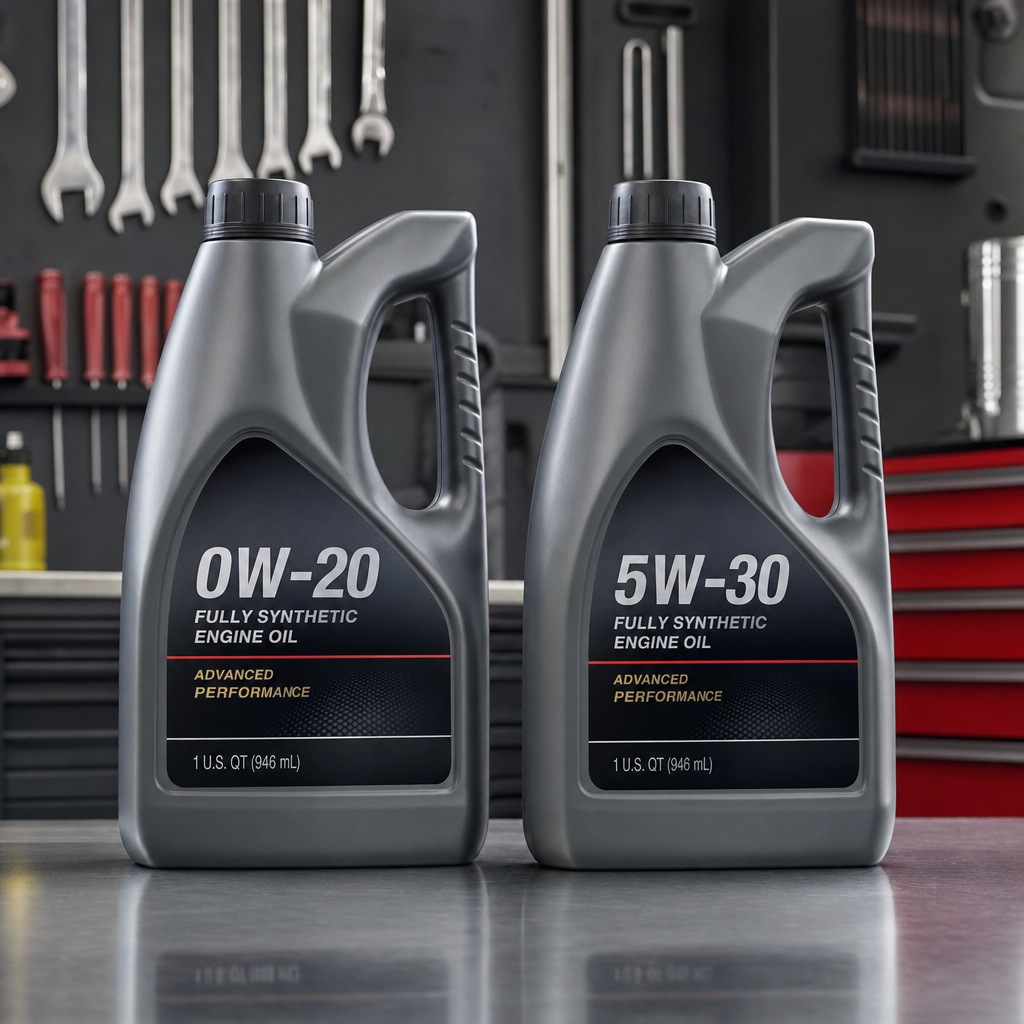
0W-20 vs 5W-30: Why do modern cars require such low viscosities?
06 October 2026
More and more manufacturers are approving 0W20 oils in engines that a few years ago ordered 5W-30, and it is not a fad: it stems from tighter engine tolerances and the drive for lower fuel consumption. Here we explain what really differentiates these two viscosities, when they are interchangeable and what happens if you don’t follow the manufacturer’s recommendation.
If you've recently changed cars and the owner's manual no longer asks for the usual 5W30 but for a 0W-20, you're not the only one asking this question. The doubt is reasonable: at first glance both oils seem "the same, but with a different number", and in the workshop or on the auto parts store shelf it is easy to think that one can replace the other. At Repsol Lubricants, we believe that before deciding, it is important to understand what each number really measures, why current engines require lower and lower viscosities, and in what cases a two-unit shift is not as innocent as it seems.
What do the numbers 0W-20 and 5W-30 mean
The nomenclature 0W20 or 5W30 is not a commercial name: it is a SAE (Society of Automotive Engineers) viscosity classification, the body that standardizes how oil fluidity is measured based on temperature. Simply put, viscosity is a fluid’s resistance to flow: the more viscous it is, the thicker and slower it moves.
Each designation has two parts:
- The number followed by the “W” (0W, 5W) indicates the performance of the cold oil, at start-up. The lower that number, the more fluid the oil is at low temperatures and the faster it reaches and lubricates all engine parts after start-up. The "W" stands for *winter*.
- The second number (20, 30) measures the operating temperature viscosity, with the engine at normal operating temperature. This is where the real difference between 0W20 and 5W30 lies: the former is also thinner at high temperatures than the latter.
A multigrade oil - as virtually all current ones are - meets both requirements thanks to additive packages that stabilize its behavior over a wide range of temperatures. If you have any doubts, consult the quick guide on viscosity that answers the most common questions.
An important nuance: the difference between 20 and 30 when hot does not translate to a universal number of centistokes or HTHS (high temperature, high shear viscosity, the parameter that actually protects the engine under demanding conditions) because formulations vary from one lubricant manufacturer to another. What remains constant is the trend: the lower the second number, the lower the film thickness.
For this reason, it is best to always consult the vehicle manual and opt for lubricants that meet the specifications required by the engine manufacturer. In this regard, Repsol's passenger car engine oils catalog include formulations adapted to different viscosity grades and the specific needs of each type of engine, whether gasoline, diesel or state-of-the-art.
For those seeking the highest level of protection and performance, Repsol's Elite range offers high-performance synthetic oils, designed to meet the thermal and mechanical demands of modern engines, including those that require high HTHS to ensure optimal lubrication in the harshest conditions.

Comparison table: 0W-20 and 5W-30 (consumption, protection, cold start)
Please note that while exact figures always depend on oil’s formulation and real-world operating conditions, here is a general trend comparison between both viscosities:
|
Aspect |
0W-20 |
5W-30 |
|
Cold flow |
Very high; reaches all engine parts faster at start-up |
High, but slightly slower than 0W in extreme cold temperatures |
|
Operating temperature film thickness |
Thinner; lower internal resistance (friction) |
Thicker; greater margin of protection under high load conditions |
|
Fuel efficiency / consumption |
Tends to reduce internal engine friction, thereby lowering fuel consumption |
Slightly higher fuel consumption compared to 0W20 in the same engine, if both are approved |
|
Cold-climate performance |
Suitable for European climates |
Suitable for European climates |
This table summarizes a general trend, not a performance guarantee: there is no single figure for consumption savings or protection applicable to all engines. Actual performance depends on engine design, the specific oil’s additive package, and operating conditions (city, highway, ambient temperature, vehicle load).
Which one does your car use? Why they cannot simply be interchanged
The right question is not “which one is better?” but “which one does my engine require?” And that answer doesn’t come from the oil: it comes from the vehicle manufacturer, through the user manual or the label under the hood.
Engines designed to work with 0W20 typically have tighter internal tolerances and components specifically designed to work with a thinner oil film: piston clearances, bearings, and camshafts calculated for that particular thickness. It's not that they “accept” a thinner oil just for the sake of it: they're built to require it as part of a strategy to reduce friction and improve fuel efficiency.
An engine originally designed for 5W30, on the other hand, may have somewhat larger clearances or lubrication systems designed to work with a slightly higher viscosity, especially under high temperature or sustained-load conditions (high-speed highway driving, towing, or very hot weather).
That's why the viscosity number is not a matter of taste or preference: it's an engineering specification. Changing from 0W20 to 5W30, or vice versa, without being expressly authorized by the manufacturer, means altering a parameter the engine was engineering around.
Can 5W30 be used in a car that requires 0W-20 (or vice versa)?
This is where it is advisable to be cautious and avoid definitive answers, as it depends on the manufacturer and what is expressly indicated in the vehicle manual.
Some manufacturers specify an acceptable viscosity range in their documentation based on usage or climate (for example, allowing 5W30 as an alternative in hot climates or under severe operating conditions, even if the factory oil is 0W-20). Others, on the other hand, strictly require the approved viscosity, and any deviation can affect the warranty or the correct operation of associated systems (such as emission control or variable valve timing (VVT) systems, which in many modern engines rely on a very specific oil pressure). The 0W-20 oil is the most common option in modern engines, and whether it can be replaced with 5W-30 depends on the specific vehicle and manufacturer guidelines in the manual.
The general rule we follow at Repsol Lubricants is clear: there are no shortcuts in lubrication. The best decision is not the one that "seems reasonable" on paper, but the one that exactly matches the specification and the approval required by the manufacturer for that particular engine. If the manual does not include alternatives, you must always use the oil specified by the manufacturer.
What happens if you use a viscosity other than the approved one
Continuously using a viscosity other than that specified does not usually cause an immediate or obvious breakdown, allowing this error to easily go unnoticed. However, their effects accumulate over time and eventually take a toll on the engine:
· Increased component wear: an inadequate oil film reduces protection between moving parts, accelerating wear on bearings, camshafts, and other critical elements.
· Poorer lubrication when cold or hot: an oil that is too thick makes cold starts more difficult, whereas an overly fluid oil loses its protective capacity at high temperatures.
· Increased fuel consumption: incorrect viscosity increases internal friction, forcing the engine to work less efficiently.
· Deposit and sludge formation: premature lubricant breakdown promotes residue buildup than can clog oil passages and affect the engine performance.
· Reduced engine lifespan: combined over the medium to long term, these factors lead to premature engine wear and the need for costly repairs.
For more details on 0W-20 approvals
Therefore, even if issues do not arise immediately, adhering to the manufacturer-recommended viscosity is key to ensuring proper vehicle operation and long-term durability.
Each manufacturer establishes its own approvals for 0W-20 oils, based on the technical characteristics of its engines and the quality standards it requires. Consulting the vehicle manual or the manufacturer's technical documentation allows you to determine exactly which approval the lubricant must meet to ensure optimal performance and prevent potential incompatibilities.