
Top tips

Differences between mineral, synthetic, and semi-synthetic oil
15 October 2026
Choosing between mineral, semi-synthetic, or synthetic oil is not just a matter of price: each lubricating base offers a different level of protection, thermal stability, and service life. In this guide, we review what distinguishes each type, its technical advantages, and which engine each one needs depending on its age and use.
At Repsol Lubricants, we work with the three bases — mineral, semi-synthetic, and synthetic — because each one responds to different engine needs. Understanding their differences will help you decide judiciously, although the final reference should always be the manufacturer's manual and the exact approval required by your engine. If you have any doubts about which oil is right for you, you can consult our vehicle lubricants search engine, where you will find the product recommended for your car’s make and model.
What is mineral or conventional engine oil?
Mineral oil (also called conventional) is obtained directly by refining crude oil, using distillation processes that separate the heavier fractions and convert them into base oil. It is the oldest lubrication technology and, although it meets the basic specifications demanded by many engines, its molecular structure is less homogeneous than that of a synthetic oil: the molecules have irregular sizes and shapes, which translates into a less stable response to sudden changes in temperature. If you want to delve into the differences between this and other types of engine lubrication, it is worth knowing how each technology behaves according to the demands of the vehicle.
This molecular heterogeneity is the key to understanding its technical limitations. A mineral oil oxidises and loses viscosity (the resistance of the fluid to flow, which determines the thickness of the lubricating film) more quickly than a synthetic one, and responds less well to both severe cold and high working temperatures. That's why, for those looking for superior performance, ranges such as Repsol Driver offer more advanced formulations capable of maintaining their lubricating properties under more demanding conditions.
What differentiates mineral oil from synthetic oil?
Synthetic oil is manufactured using synthetic chemical processes (not just refined) that generate uniform molecules with a controlled structure. This uniformity translates into three practical differences compared to mineral oil:
- Greater thermal stability: it withstands temperature peaks better without degrading or forming deposits.
- Better behavior in the cold: it flows more easily when starting at a low temperature, reducing wear in the first few seconds of operation.
- Longer lifespan: its molecular structure takes longer to oxidize, permitting (depending on the vehicle manufacturer) longer intervals between oil changes.
Mineral oil, on the other hand, usually requires more frequent changes and offers a more reduced margin of protection in demanding driving conditions (high revs, high loads, extreme climates).
What differentiates mineral oil from semi-synthetic oil?
Semisynthetic) oil (or semi-synthetic) is a mixture of mineral and synthetic bases, in proportions that vary from manufacturer to manufacturer. Compared to pure mineral oil, it provides:
- Greater resistance to rust, although lower than that of a 100% synthetic oil.
- A more stable behavior in cold and heat, without reaching the levels of synthetic oil.
- An intermediate cost, which makes it a balance between price and benefits.
In practice, semi-synthetic oil acts as an intermediate point: it improves on mineral oil in terms of protection and stability, but does not equal synthetic oil in the most demanding scenarios.
Advantages of synthetic oil
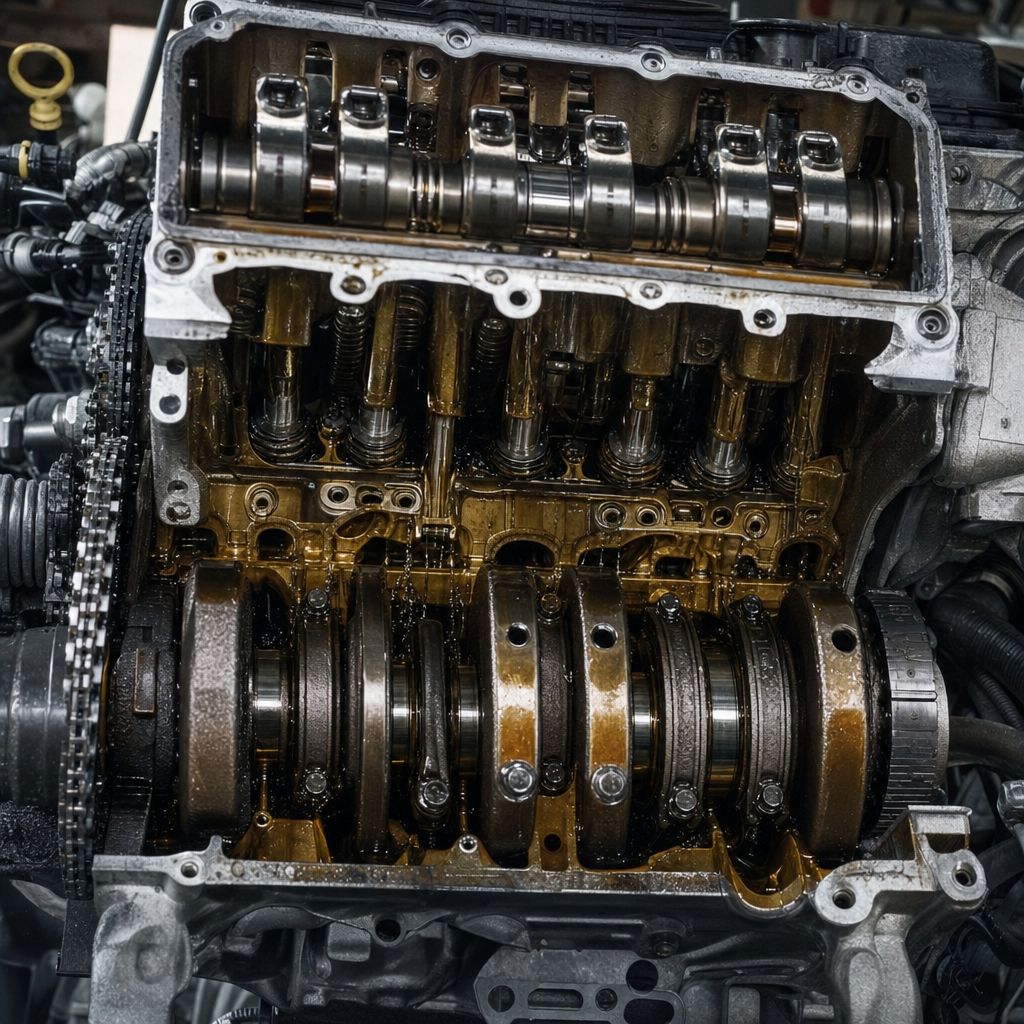
Beyond a direct comparison with mineral oil, synthetic oil provides benefits that have made it the dominant base in today's engines:
- Less internal friction, thanks to a more uniform lubricating film, which can translate into a slight improvement in engine efficiency.
- Greater resistance to the formation of deposits and sludge, especially important for engines with gas after-treatment systems (DPF/GPF particle filters, SCR catalysts), where low SAPS oils (low in sulphated ash, phosphorus, and sulfur) protect these components.
- Better response in cold starts, a critical point because a great deal of engine wear occurs in the first few minutes after starting, when the lubricating film has not yet completely formed.
- Compatibility with more demanding ACEA and API specifications, the standards that certify the performance level of an oil (ACEA is the European association of car manufacturers; API, the American one). The more modern and demanding the engine, the more likely it is that your manual will request an approval that only synthetic bases meet.
If you are looking for a synthetic oil that combines all these advantages, take a look at the Repsol Elite range, specially formulated to provide the advanced protection required by today's engines.
What engines is synthetic oil best for?
Synthetic oil is especially suitable for:
- Turbocharged and direct injection engines, in which the working temperatures are higher.
- Vehicles that are used in the city with frequent stops and starts, or in extreme temperatures (very cold or very hot).
- Modern engines that require specific ACEA/API specifications and manufacturer approvals that only synthetic bases meet, especially if they have a particulate filter or require low viscosity oils (for example, grades 0W-20 or 0W-30, where the first number indicates their behavior when cold and the second indicates their viscosity when hot).
- Sport or high-performance driving, when the engine usually works at a high speed.
In any case, the valid reference is always the exact approval that appears in the vehicle manual, not a generic recommendation of the type of base. To find the oil that meets that specification, you can consult the Repsol Master range, where you will find options suited to the different needs and approvals of each vehicle.
Advantages of semi-synthetic oil
Semi-synthetic oil does not seek to match synthetic oil, but to provide a balanced solution for engines that do not require the highest performance on the market:
- Good wear protection under normal operating conditions, without extreme temperature peaks.
- Lower cost than pure synthetic oil, but still with a notable improvement over mineral oill.
- Intermediate intervals between oil changes, higher than those for mineral oil but lower than those for synthetic oil (always as indicated by the manufacturer).
- Versatility, adapting to both mid-range gasoline and diesel engines that do not require state-of-the-art specifications.
For which engines is semi-synthetic oil best?
Semi-synthetic oil is suitable for:
- Mixed-use vehicles (city and highway) with mid-range engines and moderate age.
- Engines that do not feature the most demanding post-treatment technologies or require ultra-low viscosities.
- Drivers who seek a balance between protection and cost, provided that the manufacturer's manual does not expressly require a synthetic base.
In this segment, Repsol's Leader range offers semi-synthetic options designed to meet these needs with the quality and protection required for daily vehicle use.
How long does each type last before degrading?
The useful life of an oil depends on multiple factors - engine type, driving style, fuel quality, weather — so there is no universal figure. As a guideline, and always subject to the vehicle manufacturer's indications:
- Mineral oil: less resistance to thermal oxidation; usually requires the shortest intervals between changes on the market.
- Semi-synthetic oil: intermediate resistance to degradation; intervals between changes longer than for mineral oil.
- Synthetic oil: greater molecular stability and resistance to oxidation; allows FOR, in many cases, the longest intervals between changes approved by the manufacturer.
In lubrication there are no shortcuts: the exact number of kilometres or months between changes is determined by the engine manufacturer, not the type of base alone. Factors such as city driving with many stops, towing loads, or extreme weather can shorten these intervals considerably, even with a synthetic oil.
What oil does your engine need for its age and use?
The right choice does not depend solely on the performance of the oil, but on what was designed for that particular engine.
Modern, high-performance engines
Today’s engines — turbocharged, direct injection, with emission reduction systems (DPF, GPF, SCR)— usually require low-viscosity synthetic oils with specific ACEA/API specifications and, frequently, low SAPS formulations so as not to damage the catalysts. Using a lower performance oil than indicated can compromise both the protection of the engine and the manufacturer's warranty. The Repsol Master range is specially designed for high-powered engines.
Classic or high-mileage engines
Older engines, with higher mechanical tolerances between their internal components, require oils with a higher viscosity than modern engines. The increased space between the moving parts — pistons, cylinders, bearings — is the result of accumulated wear after years of operation or, simply, of the design and manufacturing processes at the time when they were built.
A too liquid oil in engines of this type may not form a sufficiently consistent lubricating film to fill those clearances, which results in:
- Higher oil consumption, as the lubricant can more easily leak into the combustion chamber.
- Oil pressure loss, especially at high temperatures or when idling.
- Mechanical noises due to the lack of adequate damping between metal parts.
- Greater wear as optimal lubrication is not guaranteed at all times.
For this reason, for vehicles with higher mileage or manufactured before recent decades, oils with higher viscosity grades are recommended (for example, 10W-40 or 15W-40, as compared to the normal 0W-20 or 5W-30 in current engines). This higher viscosity helps compensate for wear, better seals clearances, and helps keep oil pressure within the proper parameters, protecting the engine and extending its service life.
It is important to always consult the manufacturer's manual or a specialist before choosing the right oil, as each engine has specific needs depending on its age, condition, and operating conditions.
Can oils with different bases be mixed?
Although in a specific situation — such as a roadside emergency — it is possible to add an oil with a different base to the one already in the engine, it is not advisable to make this practice normal. Mineral, semi-synthetic, and synthetic oils have different refining processes and additive packages, so mixing them can alter their properties and reduce their ability to lubricate, protect, and clean the engine.
If you need to top up the oil level and you do not have the same product, it is advisable to temporarily use one of similar characteristics and, as soon as possible, make a complete change with the oil recommended by the manufacturer. In this way, you will avoid compromising the performance and service life of the engine in the long term.